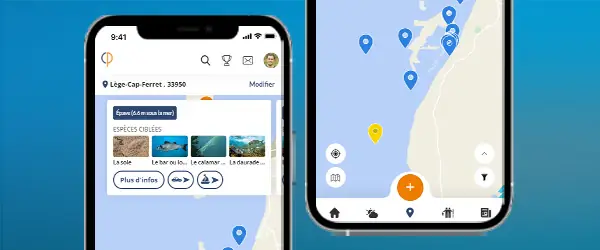


Read the article with FishingTheSpot: plug-drift fishing for sea bream
Keep an eye on this subject!
Thousands of species spotlights and techniques but also all the local information about your city!

Meet other anglers near you and share your fishing fishing trips, afoot or on a boat, at sea or in freshwater
See the fishing tripsPlug-drift fishing for sea bream
This technique, whether practiced by boat or kayak, consists in letting yourself drift with a fairly simple setting consisting of a plug, a leaded wire with one or more hooks.
Description
This technique requires a little practice since it is a question of knowing the right places (a high ground, a drop-off, a large sandbank where food is particularly abundant...). In order to probe the spots, a sonar is almost essential, at least a precise study of the seabed maps.
Once the spot is found, it is necessary to go upstream of the direction of the drift by going around it (so as not to frighten the fish) in such a way that the drift makes the boat, and therefore the hook, pass through the spot.
In order for the bait to pass as close as possible to the structures, the mounting allows to adjust the distance between the hook and the plug. If after two or three drifts, no fish bites, you should consider changing the depth. If despite these variations you are empty, either the spot is empty or the spot is not good... you will see this by returning regularly.
The most effective bait is grey shrimp or live sand shrimp. Its whiteness allows it to be clearly visible in the water and its movements will only attract fish. However, it is difficult to find bait because it is a matter of fishing them and keeping them alive until the time of fishing. The squid is still very effective and the raw or bleached shell holds well on the hook.
Once the plug is inserted into the water with a sharp blow, the fisherman must tighten the sea bream by pulling a small sharp blow on the rod. However, for this type of fishing, the fish usually fishes on their own.
Material
<p><strong>Rod
</strong>The type of rod does not drastically influence fishing since there is no animation to be done. However, the thinner the rod, the more you will have a good feeling when going up the fish. A 10-30g cane is sufficient.
<strong>Reel</strong>
A sea reel between 2000 and 4000 is suitable for this type of fishing.
<strong>Line
</strong>Line body: Braid in 13 hundredths
Leading edge: Fluorocarbon in 13 hundredths
<strong>Plug
</strong>The plug should have a flotation of about 25-30 grams depending on the current.
Lead
Olive Lead corresponding to about 1/3 of the flotation of the cap.
Hook
Hooks N°1 or 2 can be used. Good quality hooks are required. In other words, they are very spicy, strong and as light as possible in order to maximize their chances on a fish whose distrust cannot be overstated.
</p>
Bait for float fishing
Many baits can be used for plug fishing. The first type that comes to mind are marine worms, also called semi-hard or hard. The bait is chosen according to the type of fish desired. They are very varied: doughs made from flour that can be made yourself, bread crumbs, shelled mussels, seaweed, machottes, shrimps (animated or not), sardines and many other possibilities.
To avoid making mistakes, it is better to fish with someone who has experience in float fishing or take a few courses. And as always, be patient !
Baiting:
The worm is threaded all the way through a wormhole needle. The tip of the needle is placed on the tip of the hook and the worm is transferred from the needle to the hook. The worm often has one of its ends at the bottom of the line. This technique has the advantage of not damaging the worm too much and fixing it in such a way that the sea bream sows the entire bait and all of a sudden.
Setting and baiting of soft or hard crab
Soft crabs are excellent for the sea bream. These soft crabs are crabs that are moulting (changing shells). Their appearance is a little whitish. They can be fished by hand under pebbles or in rocks at low tide. Soft crabs are rarer than hard crabs, so be patient when you pick them up. As breams have a powerful jaw that allows them to crush their prey, they can also engulf hard crabs.
Advantages:
- Relatively easy to find
- Very attractive for sea bream
- Fits well on the hook
- Rather selective, few other species will bite (sea bream or sea bass)
Disadvantages:
- Very difficult to find and present on the hook
Baiting
The first is to hook it with a single hook on the hind legs that have been removed beforehand. The crab will keep its mobility and make itself more attractive to predators.
For the second, catch the crab with two hooks, which will limit the risk of stalling during the throw and limit the losses when you hook the fish. With this method, the fish are still more suspicious. One hook will be passed through the belly, which comes out through the back, and the other in the other direction.
